

Risk Management · 2025
In this section3 topics
Risk Management Policy & Plan
Policy & Plan Description
Business operations with systematic organizational management, under risk management that covers all business activities and linked to internal control systems and effective internal audits. It is a process that will help UV Group achieve its goals both strategy and performance under the changing environment and business competition as well as being able to respond to the needs of all stakeholder groups in a balanced manner and reduce the risk of loss that may arise from various uncertainties. UV aims to promote risk management as part of the corporate culture by providing a risk management structure that clearly defines the duties and responsibilities of those involved. It also establishes an appropriate risk management system based on international standards of The Committee of Sponsoring Organizations of the Treadway Commission (COSO), the Corporate Governance Code for Listed Companies 2017 (CG Code) and Anti-Corruption guidelines as well as establish a risk management policy and determine the level of risk that is acceptable to the organization (Risk Appetite).
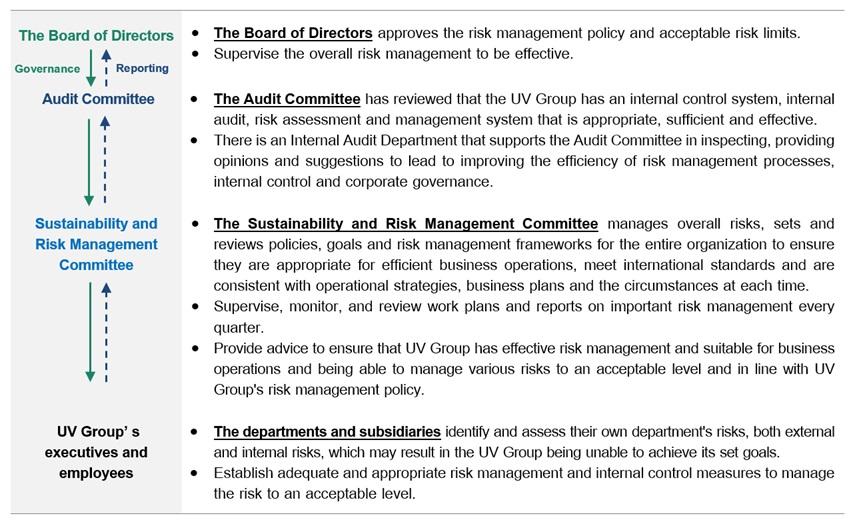
The Company has determined to operate systematically according to the above risk management structure and various risk management tools are used, such as setting the organization's risk appetite, setting key risk indicators (KRI) which are reviewed and improved regularly to align with the organization's strategy, setting a mitigation plan. Including cultivating a risk management culture within UV Group, such as organizing risk workshops for executives and management, organizing training to promote understanding among employees, and supporting directors and executives to participate in various activities to enhance their knowledge and understanding of risk management. In addition, each business is required to prepare a Business Continuity Plan (BCP), setting a process or plan to manage crises and major risks that may occur in the business operations of each business, which are monitored and reviewed regularly to reduce risks that may affect business operations.
Policy Document Link
https://www.univentures.co.th/pdf/sustainable/นโยบายบริหารความเสี่ยง_EN_May2023.pdf
Risks to the Company's Business Operations
Risk Register
| Risk Name | Risk Characteristics | Consequences | Management Measures | Related Risk Factors |
|---|---|---|---|---|
| Risk from the Company's business by investing in other companies | UV operates investment business in various companies. Therefore, UV's performance and ability to pay dividends depend on the performance and dividends received from subsidiaries. | In the case subsidiary's operating results did not meet the target due to the impact of various internal and external factors, causing a loss or inability to pay dividends as expected. It will directly affect the operating results, financial position and ability to pay dividends of UV. | In order to reduce such risks, UV has required subsidiaries to prepare annual business plans and goals. The said business plan must be considered and approved by the Board of Directors of each business in which there are representatives of UV as directors in each business. In addition, the management of the subsidiary has a duty to report the operating results to UV’ s Executive Committee every month and report risk status and risk management measures to Sustainability and Risk Management Committee and Audit Committee every quarter before presenting the operating results and risk reports to the Board of Directors every quarter. It is one way that helps UV to monitor and drive subsidiaries to achieve the operating results as planned or can plan to manage risks that may occur in a timely manner. | 765 · Description: Fluctuation in return on assets or investment · Info category: FINANCIAL_RISK |
| Risk from power plant management to operate stably | The main mission of UVBGP Group's power plants is efficiency and stability in the production and delivery of electricity to customers under power purchase agreements. The power plants that are already in operation need maintenance and improvement of machinery and equipment in order for the production process to be efficient and stable. For example, it can produce electricity according to the production plan continuously without a sudden cessation of production, including maintaining the heat rate, which affects the cost of electricity production, to enable power plants to generate electricity using resources efficiently and with reasonable production costs. In the fiscal year 2025, the average heat rate of SSUT and PPTC power plants was 7,567.36 BTU/kWh and 7,494.73 BTU/kWh, in line with the target of not exceeding 7,630 BTU/kWh and not exceeding 7,530 BTU/kWh, respectively. The availability factor of SSUT and PPTC power plants was 99.75% and 95.83%, compared to the target of not less than 98.00% due to the PPTC power plant shutting down operations for unscheduled machinery repairs and a plant blackout incident due to external factors. UVBGP Group power plants manage these risks by (1) establishing a systematic maintenance plan for power plant machinery and equipment and monitoring compliance with the plan; (2) continuously developing, reviewing, and enhancing the knowledge and skills of power plant employees in machine control; (3) installing AI-based software to process machine operation data, which will provide early warnings if problems are detected (anomaly detection) to facilitate troubleshooting before damage occurs; (4)securing insurance to cover damage to power plant machinery, equipment, and assets, including business interruptions and lost revenue; (5) developing a business continuity management system based on the ISO 22301 standard. This requires critical business units to have a business continuity plan, conduct regular training exercises, and review the system's operational performance through external audits to prepare for and mitigate the potential impacts of business disruptions; and (6) establish measures and procedures for testing the power supply system with the Metropolitan Electricity Authority to prevent disruptions in the production and supply of electricity at both power plants. | If the power plant is unable to efficiently produce and deliver electricity to customers as per the power purchase agreement, it will result in additional costs and expenses from the plan, affecting the business performance and reputation of the power plant. | UVBGP Group power plants manage these risks by (1) establishing a systematic maintenance plan for power plant machinery and equipment and monitoring compliance with the plan; (2) continuously developing, reviewing, and enhancing the knowledge and skills of power plant employees in machine control; (3) installing AI-based software to process machine operation data, which will provide early warnings if problems are detected (anomaly detection) to facilitate troubleshooting before damage occurs; (4) securing insurance to cover damage to power plant machinery, equipment, and assets, including business interruptions and lost revenue; (5) developing a business continuity management system based on the ISO 22301 standard. This requires critical business units to have a business continuity plan, conduct regular training exercises, and review the system's operational performance through external audits to prepare for and mitigate the potential impacts of business disruptions; and (6) establish measures and procedures for testing the power supply system with the Metropolitan Electricity Authority to prevent disruptions in the production and supply of electricity at both power plants. | 742 · Description: Human error in business operations · Info category: OPERATIONAL_RISK |
| Risk from relying on a single fuel supplier and fluctuations in fuel prices. | UVBGP Group's power plants use natural gas as the main fuel for electricity and steam generation. Power plants only purchase natural gas from PTT Public Company Limited (“PTT”). As natural gas is a significant cost in the operation of UVBGP Group's power plants, if fuel costs increase significantly and UVBGP Group's power plants are unable to pass on such increased fuel costs to customers, it may result in a decrease in the profit margin of UVBGP Group's power plants and have a negative impact on the operating results and financial position. | UVBGP Group's power plants may be at risk of having to stop their production processes and being unable to produce electricity and steam in accordance with the existing power and steam purchase agreements, if PTT is unable to procure and/or deliver natural gas to UVBGP Group's power plants in the specified quality or quantity. In addition, if the price of natural gas increases significantly and UVBGP Group's power plants are unable to pass on such increased fuel costs to customers, it may result in a decrease in the profit margin of UVBGP Group's power plants and have a negative impact on the operating results and financial position. | In order to manage such risks, UVBGP Group's power plants have entered into a long-term natural gas supply and use contract with the quality and quantity of natural gas specified with PTT, which has the potential to manage the natural gas procurement of Thailand, as well as procuring other natural gas distributors to increase purchasing options of UVBGP Group's power plants. In addition, to reduce the impact of natural gas price fluctuations, UVBGP power plants focus on increasing fuel efficiency in the production process by upgrading the efficiency of gas turbines, improving the power distribution system (Island Operation Improvement) to increase the flexibility of electricity supply to industrial customers, adjusting the load transfer system to be suitable for the operation of the power plant to increase the heat rate to reduce natural gas use, operating in half block mode during the period when customers have low electricity demand to reduce natural gas use. | 735 · Description: Reliance on large partners / distributors or few partners / distributors · Info category: STRATEGIC_RISK |
| Risk from relying on electricity purchases from the Electricity Generating Authority of Thailand | The main customer of SSUT and PPTC power plants is EGAT, with power purchase agreements with EGAT representing 75% of the total production capacity of each power plant. SSUT and PPTC power plants have to comply with various conditions and obligations. | SSUT and PPTC power plants are required to comply with the terms and conditions stipulated in the power purchase agreements. Failure to do so could result in penalties or even termination of the agreements, which would significantly impact their operating results due to the loss of recurring revenue from major customers. | In the past, SSUT and PPTC has always complied with the terms of the power purchase agreement with EGAT, meanwhile both power plants are continuously expanding their distribution of electricity and steam to other industrial customers. Including expanding the business to related services such as energy optimization services, electrical system consulting services and offering renewable energy solutions to increase the diversity of customer groups and sources of revenue. | 734 · Description: Reliance on large customers or few customers · Info category: STRATEGIC_RISK |
| Risk of dependence on revenue from limited customers in the refrigerator business and zinc oxide powder business | Refrigerator Business PIC's main customers are OEM customers of minimart refrigerators, which in the fiscal years 2025, sales from OEM customers accounted for approximately 40% of total sales revenue. Therefore, PIC is exposed to the risk of relying on limited customers. Zinc Oxide Powder Business The major customer of TL in the fiscal year 2025 (1 October 2024 – 30 September 2025) are tire manufacturers and distributors that has total purchase order value approximately at 63% of the total order value. Therefore, TL has a risk of relying on a limited customer. | Refrigerator Business If the overall OEM customers or large OEM customers reduce orders and PIC cannot find other customers to replace them, or if an event occurs that prevents OEM customers from ordering products or conducting business with PIC, it will have a significant impact on PIC's financial position and performance. Zinc Oxide Powder Business If the tire manufacturer and distributor group reduces its production capacity no matter what the cause, it will significantly impact revenue and business performance of TL. | Refrigerator Business PIC is aware of such risks and has a policy to increase revenue from expanding customer groups in various businesses and general customers. In addition, PIC aims to build good relationships and/or business cooperation with current OEM customers to increase production efficiency and develop products to meet the needs of each OEM customer. Zinc Oxide Powder Business TL has a strategy to reduce the risk of relying on limited customers by focusing on research and development of current product quality and adding new products. that are diverse and can meet a wide range of users with diverse needs to expand domestic and international customers in various industries, such as agricultural industry, pharmaceutical industry, cosmetic industry. | 734 · Description: Reliance on large customers or few customers · Info category: STRATEGIC_RISK |
| Risks from fluctuations in raw material prices and exchange rates of the zinc oxide powder business | The main raw materials for the production of zinc oxide powder are zinc ingots and recycled zinc. The price of zinc ingots is based on the average price in the LME market, which fluctuates constantly depending on supply and demand at each period. During the first nine months of 2025, the price of zinc ingots fluctuated between 2,521.00 USD and 3,102.00 USD per metric ton, compared to the same period in 2024, when the price fluctuated between 2,364.45 USD and 2,955.69 USD per metric ton. Therefore, the fluctuation of raw material prices creates a risk that finished goods produced from zinc ingots during the high price range will have a higher selling price than the selling price of zinc oxide powder produced from zinc ingots during the low price range, affecting customer purchasing decisions. In addition, TL procures some of the zinc ingot from the foreign supplier or producers based on the average price in the LME market, which is denominated in USD, as well as selling zinc powder to foreign customers, resulting in TL being exposed to the risk of exchange rate fluctuations. In the fiscal year 2025 (1 October 2024 – 30 September 2025), the Baht moved in the range of 32.16 – 34.61 Baht per USD, compared to the same period last year when the Baht moved in the range of 32.15 – 37.30 Baht per USD. | The fluctuation of raw material prices creates a risk that finished goods produced from zinc ingots during the high price range will have a higher selling price than the selling price of zinc oxide powder produced from zinc ingots during the low price range, affecting customer purchasing decisions. In addition, exchange rate fluctuations may adversely affect TL's business, financial condition, and results of operations, including TL's price competitiveness. | TL has a policy to reduce the risk from the volatility of zinc ingots prices by closely monitoring the price of zinc ingot in LME and the market conditions of industries that are major customers of TL such as tire industry, rubber industry in order to use such information for setting appropriate targets of prices and quantity for forward purchase to manage costs, while maintaining sales and profit margins as targeted and having sufficient raw materials for production according to customer orders at each period. In addition, TL manages exchange rate risk by entering into forward contracts and managing cash flows of foreign currency income and expenses in accordance with each other. | 740 · Description: Shortage or fluctuation in pricing of raw materials or productive resources · Info category: OPERATIONAL_RISK · 764 · Description: Fluctuation in exchange rates, interest rates, or the inflation rate · Info category: FINANCIAL_RISK |
| Risks from price competition of the zinc oxide powder business | TL faces the risk of new zinc oxide powder producers entering Thailand, which could impact both existing producers and TL. | In the case where new entrepreneurs have lower production costs and offer products at prices lower than the market price or have better products and services, this will result in more intense price competition, resulting in lower profits from product sales, and existing entrepreneurs, including TL, may lose market share and some customers who purchase products based primarily on price. | TL, as a zinc oxide powder producer with over 40 years of expertise and experience, maintains international production standards and quality control and continuously develops its products and manufacturing processes to meet customer needs at prices commensurate with the quality and service provided, including expanding its product range to expand customer bases in new industries. This mitigates the impact of price competition and the loss of market share and customers from new entrants. | 1714 · Description: Competition risk · Info category: STRATEGIC_RISK |
| The slowdown in demand and purchasing power of real estate customers is limited by several negative factors | In the first half of 2025, despite the real estate sector being supported by government measures, including reductions in transfer and mortgage fees and the relaxation of loan criteria under the Bank of Thailand's temporary LTV measure, the severe earthquake in Thailand in March 2025 significantly impacted customer confidence in purchasing condominiums for residential or investment purposes. SCB EIC expects the earthquake to cause condominium transfers in Bangkok and its vicinity to contract by 0.8% YoY in 2025, down from the previous 2.6% YoY growth forecast. This is because customers are postponing transfers or purchase decisions to assess the safety of high-rise buildings and awaiting completion of repairs to buildings and common areas. Meanwhile, investors are delaying investments due to uncertainties such as resale prices and tenants' move-outs to rent low-rise properties. Furthermore, household debt-to-GDP ratio in the first quarter of 2025 stood at 87.4%, and loan quality continued to decline, particularly in personal consumption loans. The non-performing loan (NPL) ratio to total loans in the first quarter of 2025 rose to 3.4%, leading financial institutions to tighten their lending practices for all types of households. In the first quarter of 2025, housing loan growth slowed to 1.9% YoY, while foreign purchasing power was impacted by the global and Chinese economic slowdowns. Due to these negative factors, SCB EIC expects condominium unit and transfer value in Bangkok and its vicinity to contract by 1.0% to 3.0% YoY in 2025, down from the previous 1.0% to 3.0% growth projection. | The slowdown in housing demand and purchasing power due to the aforementioned negative factors has significantly impacted sales and revenue of all condominium developers, including GRAND UNITY. | GRAND UNITY adjusts marketing strategies and selling prices to suit the economic conditions, competition in the real estate market and the needs of target customers coupled with an aggressive marketing strategy by focusing on marketing with customers who buy condominiums for real living, organizing promotional activities in various formats continually to attract and drive customers' purchasing decisions, increasing sales channels through online channels and sales agents to increase the reach of target customers more widely, including improving the quality of service both before and after the sale to increase the satisfaction of current customers and create opportunities for referrals to new customers. | 1714 · Description: Competition risk · Info category: STRATEGIC_RISK · 1715 · Description: Economic risk · Info category: STRATEGIC_RISK |
| Risk from interest bearing debt | As of 30 September 2025, UV Group has liabilities with interest burden of 15,978.40 million Baht which is loan from financial institutions for investing in new businesses and developing projects in the past, including as working capital for UV Group's operations. Loans from financial institutions have fixed interest rates and conditions that must be complied with, such as maintenance of debt-to-equity, maintenance of loan to building value based on valuation report, maintenance of shareholding proportion of the parent company in the highest order, right transfer in insurance contract and construction contract, placing assets as collateral, etc. | In the event that UV Group is unable to repay the loan and/or comply with the conditions stipulated in the loan agreement will cause UV Group to breach the loan agreement and financial institutions may demand repayment of the loan in full or enforce collateral which will affect the business operation of UV Group. | In the past, UV Group has been able to repay loans and comply with the terms and conditions of the loan agreements as specified by the financial institution. UV Group also manages its risks by regularly monitoring trends in interest rates and exchange rates to enter into interest rate swap contracts in the ratio appropriate to the income structure as well as entering into forward foreign exchange contracts together with the management of cash flows of income and expenditures in foreign currencies accordingly. In addition, because some of the subsidiary's loans are based on floating interest rates and must pay interest and principal in foreign currency. | 764 · Description: Fluctuation in exchange rates, interest rates, or the inflation rate · Info category: FINANCIAL_RISK |
| Safety, occupational health, social and environmental risks of the power plant, zinc oxide powder and refrigerator business | As the Company invest in various businesses, the Company's normal operations do not have significant safety, occupational health, social, and environmental risks. However, the Company may be exposed to such risks from investing in businesses that may negatively impact the safety, occupational health, social, and environmental of stakeholders. The Company has a policy and requires UV Group to operate their business in strict compliance with laws, quality standards, policies, and requirements on safety, occupational health, social, and environmental matters. The Company also ensures efficient use of natural resources and energy, and implements sound environmental and waste management. Furthermore, during the investment consideration process, the Company assesses the risks and impacts on stakeholders, society, and the environment that may arise from the operations of the business in which it will invest before making an investment decision. The risks and risk management approaches related to safety, occupational health, social, and environmental in UV Group's operations are as follows: Risk from power plant production process Communities and industrial plants located near power plants can be affected by air pollution and noise generated by the power plant's production process. Risk from zinc oxide powder and refrigerator manufacturing process With the production of zinc oxide powder using large machinery, high temperature furnaces, noisy production lines and dust generated around production lines and packing plants. Similar to refrigerator manufacturing process, which uses machinery for cutting, welding, and assembling sheet metal, the use of chemicals can pose risks to safety, occupational health, and employee well-being. | Safety, health, social and environmental risks can impact a business directly or indirectly, such as financial loss from accidents or fines, reputational and image damage, loss of investor and customer confidence, business disruption from supply chain issues and potential legal disputes. | Power plant business Both power plants have continuously implemented environmental management measures in accordance with the ISO 14001 international standard since the beginning of their operations. In addition, there are ongoing community relations activities such as organizing a tripartite committee meeting (comprising community representatives, government officials in the area, and the Industrial Estate Authority of Thailand) to listen and resolve the impacts from the power plant operation regularly twice a year. In addition, both power plants set policies that emphasize the importance of operating according to the work instructions correctly and safely. No accidents involving the operators were found, causing them to stop working since the two power plants started operating. Moreover, PPTC and SSUT regularly conduct emergency drills in many cases, such as fire drills, chemical spill drills, oil spill drills, so that employees are aware of various risks that might happen and are able to perform duties properly and effectively in the event of an emergency. Zinc oxide powder and refrigerator business TL and PIC have taken various measures to mitigate business risks that may impact stakeholders. For example, provide employees with protective clothing and equipment against heat, noise, dust, or chemicals, and maintain a clean, orderly work area with an environment suitable for work. Furthermore, inspect and maintain machinery and equipment to ensure they are in good condition and ready for use. Establish work procedures to increase safety and create a better quality of life for employees, strictly adhering to relevant legal requirements and human rights principles, such as the installation of ventilation fans, determining the working hours of employees in the furnace work to take breaks from time to time regularly. In addition, TL and PIC provide health checks for employees along with the annual environmental quality analysis within the factory by independent external auditors in order to supervise the business operations in accordance with the requirements of laws and standards on environment, energy, labor and human rights rules. | 749 · Description: Safety, occupational health, and working environment · Info category: OPERATIONAL_RISK · 751 · Description: Impact on the environment · Info category: OPERATIONAL_RISK |
| Risks from government policies, compliance with relevant laws, regulations and rules | Changes in government policies, laws, regulations and rules related to business operations, if UV Group does not comply or cannot comply correctly and completely, it may be a risk factor that affects the reputation, loss of business opportunities or penalties and fines for each business. | If UV Group does not comply or cannot comply correctly and completely, it may be a risk factor that affects the reputation, loss of business opportunities or penalties and fines for each business. | The Company requires its departments and subsidiaries to regularly monitor changes in government policies, laws, regulations and rules related to their business operations, including improving the regulations, rules and practices, policies and practices on good corporate governance, anti-corruption, risk management and sustainable development, to be consistent with new or changed government policies, laws, regulations and rules, and to communicate them to UV Group's employees so that they are aware and comply. In addition, it may consider having a legal consultant with expertise to provide recommendations and/or take actions to ensure that UV Group complies correctly and completely with the relevant laws, regulations and rules. | 756 · Description: Change in laws and regulations · Info category: COMPLIANCE_RISK |
| Climate Change Risk | Climate change from global warming that is becoming more severe, in addition to causing the business sector to be directly and indirectly affected by physical risks such as severe natural disasters, droughts that result in water shortages, may affect the production or delivery of goods of the business sector, as well as affecting the income or purchasing power and business expansion plans of customers. In addition, the international community has expressed its intention to move towards a low-carbon society at the Conference of the Parties of the United Nations Framework Convention on Climate Change, with the goal of achieving net zero greenhouse gas emissions (“Net Zero”) by 2050. This includes Thailand, where Prime Minister Anutin Charnvirakul has announced a policy to push Thailand towards a low-carbon economy and society to cope with international trade. By adjusting the target for Thailand to achieve Net Zero by 2050, like 111 other countries, Thailand's move 15 years earlier from the original target of 2065 marks a significant shift in Thailand's climate policy that will impact the industrial sector due to risks associated with adapting to a low-carbon economy and society (Transition Risk). | The industrial sector is incurring costs to develop environmentally friendly products and services, and operating costs are increasing due to the enforcement of new laws related to greenhouse gas emissions and government measures such as renewable energy purchase targets, carbon taxes, and the implementation of the Emission Trading System, particularly for businesses or industries with high greenhouse gas emissions, such as oil and gas, fossil fuel power plants, chemicals, construction materials, aluminum, and transportation. | UV Group is constantly monitoring the situation, assessing the likelihood of impacts and the extent of climate change risk impacts, to enable each business to develop appropriate risk management plans for business continuity management and maintaining competitiveness. For example, the power plant and zinc oxide powder businesses began conducting Carbon Footprint for Organization (CFO) assessments from 2021 and conduct product carbon footprint (CFP) assessments in 2024 and 2025, respectively, along with continuously optimizing energy use (natural gas and electricity for the power plant and zinc oxide powder businesses) to maximize efficiency. This aims to reduce overall GHG emissions and GHG emissions per unit of production, coupled with the procurement or development of products and services that align with environmental standards and criteria and support the growing customer demand for environmentally friendly or energy-saving products and services, such as:
| 750 · Description: Climate change and disasters · Info category: OPERATIONAL_RISK |
| Cybersecurity and Data Security Risks | As the business sector has changed its way to operate business and working method by applying information technology (“IT”) in production process and corporate management increasingly such as using automated system in the production processes of power plants and industrial plants, connecting information between departments and contacting related individuals of UV Group via internet, this results increase exposure of UV Group’s business operations to risks from internet and cyber threats such as network attack and access into relevant internal information of UV Group such as product development information, trade information, and customer personal information by external individuals with no relation and without approval for demolition or using such information in ways that cause damages to UV Group. Such threats may lead to impact on finance, business operations, reputation, and credibility of UV Group such as increase of costs from expenses on legal actions and/or from fines for disclosing personal information, loss of intellectual information and customer information owned by UV Group, etc. | Such threats may lead to impact on finance, business operations, reputation, and credibility of UV Group such as increase of costs from expenses on legal actions and/or from fines for disclosing personal information, loss of intellectual information and customer information owned by UV Group, etc. | The Company has established an Information Technology Security Policy, which establishes guidelines for controlling access to and use of the Company's IT systems, data backup, data system restoration, and emergency preparedness, including auditing, risk assessment, and internal data control. Executive-level responsible persons and the IT Department are designated to be responsible for monitoring, supervising, and implementing various actions in accordance with these guidelines. The Company also has a data backup and recovery system, conducting annual rehearsals based on the data system recovery plan, and implementing preventative measures through training on the proper and safe use of technology for employees to avoid cyber threats. This aims to raise awareness of cyber threats and keep employees up-to-date on the situation. In fiscal year 2025, UV's IT Department will increase the installation of Endpoint Detection and Response (EDR) systems in critical systems, along with performing preventative maintenance on critical systems and equipment. It will also organize annual cybersecurity training for directors, executives, and employees as planned. Furthermore, it is preparing to conduct an IT security assessment based on the National Institute of Standards and Technology's (NIST) Cybersecurity Framework to assess UV Group's cybersecurity status. This will lead to the establishment of effective IT security targets and measures, which will reduce the risk of cyberattacks and protect the organization's sensitive data. Regarding personal data, the Personal Data Protection Department monitors and ensures that all departments and businesses comply with relevant laws and regulations, such as the Personal Data Protection Act, regarding data protection, proper use, storage, and destruction. In fiscal year 2025, the Personal Data Protection Department reviewed and updated the personal data protection policy and privacy notice for the Company's stakeholders, including customers, business partners, shareholders, employees, and job applicants. The department also collaborated with departments and subsidiaries to review and update documents related to the collection, use, and disclosure of personal data, including the Record of Processing Activities (ROPA) and the data flow diagram, to enhance UV Group's compliance with personal data protection laws. Furthermore, the department organized training and disseminated educational materials to review personal data protection practices for executives and employees to raise awareness and assist UV Group personnel in handling personal data in accordance with the law and established guidelines. | 744 · Description: Information security and cyber-attack · Info category: OPERATIONAL_RISK |
Risks to Securities Holders' Investment
Risk Register
| Risk Name | Risk Characteristics | Consequences | Management Measures | Related Risk Factors |
|---|---|---|---|---|
| Risk of uncertainty in the ability to pay dividends and the return that investors will receive | The Company's ability to pay dividends depends on many factors, such as the operating results of its subsidiaries, capital reserves for investment plans in new companies or businesses, loan repayments, etc. Such factors affect its ability to pay annual dividends and put the Company at risk of paying dividends at lower rates than investors expect. In addition, the Company's share price may increase or decrease depending on various factors which the Company cannot control, such as economic conditions, crises, unusual situations or changes in accordance with policies, rules, regulations or conditions which significantly affects the business operations of the Company’ s subsidiaries. Such factors may cause the Company's share price to fall below the investor's buy price and/or above the investor sell-off price. Therefore, investors may be at risk from the uncertainty of the return that investors will receive as expected. | Shareholders or investors do not receive dividends or receive dividends at a lower rate than expected. In addition, the Company's share price falls below the price at which investors buy and/or above the price at which investors sell their shares, causing investors to be exposed to the risk of uncertainty in the returns that investors will receive as expected. | 769 · Other name: Risk from uncertainty of dividends and returns that investors will receive · Description: Other · Info category: HOLDER_RISK | |
| Management risk of major shareholders | As of 2 October 2025, Adelfos Company Limited (“Adelfos”) and its subsidiary (Siribhakditham Company Limited) hold the Company’s shares totaling 1,267,532,605 shares or 66.30% of total shares sold of the Company. As a result, these shareholders (Mr. Thapana Sirivadhanabhakdi and Mr. Panote Sirivadhanabhakdi, directors of the Company, each holding 50.00% of Adelfos’ shares) were able to control almost all resolutions at shareholders’ meetings, including the appointment of directors and other matters requiring a majority vote of the shareholders’ meeting. This is except for matters that the law or the Company’s regulations require a three-quarters vote of the shareholders’ meeting. | Minority shareholders may not be able to muster the necessary votes to check or balance the matters proposed by Adelfos. | The Company’s management structure comprises of the Board of Directors and subcommittees in which each committee has clear scope of authority in order to ensure that the Company’s management has transparency and accountability. Furthermore, the Company prescribes policy to manage conflict of interests in which directors, executives, or stakeholders in such transaction must not be involved in decision-making and the connected transaction must go through review or consideration of Audit Committee which has no interest in the connected transaction. The Company must also disclose information of the connected transaction according to the process required by laws or regulations of regulatory authority. The aforementioned management structure and policy to manage conflict of interests are approaches to reduce impacts of such risk. | 2969 · Description: Risk of the company having a majority shareholder holding > 50% of shares · Info category: HOLDER_RISK |